Showing posts with label never-gonna-happen ideals. Show all posts

Monday, January 25, 2010

Bernanke

In any other profession, a performance as bad as Bernanke's over his first term would get someone fired. Under his watch, our financial sector collapsed and sent our country into a recession. That he has done a decent job cleaning up in the aftermath is inconsequential: in industry, he'd be gone. So why is it that he has a good chance of getting a second term? Other than a made-for-TV grilling by Congress in which he got yelled at, Bernanke has hardly suffered for all his blunders.


Anyway, sorry for the pointless rant.
Let's hope Bernanke can help to turn our economy around in his next term, assuming he gets it.

Krugman has a good writeup on this topic:

What happened here? My sense is that Mr. Bernanke, like so many people who work closely with the financial sector, has ended up seeing the world through bankers’ eyes. The same can be said about Timothy Geithner, the Treasury secretary, and Larry Summers, the Obama administration’s top economist. But they’re not up before the Senate, while Mr. Bernanke is.

Given that, why not reject Mr. Bernanke? There are other people with the intellectual heft and policy savvy to take on his role: among the possible choices would be my Princeton colleague Alan Blinder, a former Fed vice chairman, and Janet Yellen, the president of the San Francisco Fed.

But — and here comes my defense of a Bernanke reappointment — any good alternative for the position would face a bruising fight in the Senate. And choosing a bad alternative would have truly dire consequences for the economy.

Furthermore, policy decisions at the Fed are made by committee vote. And while Mr. Bernanke seems insufficiently concerned about unemployment and too concerned about inflation, many of his colleagues are worse. Replacing him with someone less established, with less ability to sway the internal discussion, could end up strengthening the hands of the inflation hawks and doing even more damage to job creation.

That’s not a ringing endorsement, but it’s the best I can do.

If Mr. Bernanke is reappointed, he and his colleagues need to realize that what they consider a policy success is actually a policy failure. We have avoided a second Great Depression, but we are facing mass unemployment — unemployment that will blight the lives of millions of Americans — for years to come. And it’s the Fed’s responsibility to do all it can to end that blight.

Monday, January 11, 2010

New Year Reading

  • John Taylor, inventor of the Taylor Rule, responds to Bernanke's speech in the WSJ. I add emphasis in the excerpt below:
    ...Mr. Bernanke focused most of his time on my research, especially on a well-known policy benchmark commonly known as the Taylor rule.
    This rule calls for central banks to increase interest rates by a certain amount when price inflation rises and to decrease interest rates by a certain amount when the economy goes into a recession. My critique, which I presented at the annual Jackson Hole conference for central bankers in the summer of 2007, is based on the simple observation that the Fed's target for the federal-funds interest rate was well below what the Taylor rule would call for in 2002-2005. By this measure the interest rate was too low for too long, reducing borrowing costs and accelerating the housing boom. The deviation from the Taylor rule, which had characterized good monetary policy during the previous two decades, was the largest since the turbulent 1970s.

    ...Stepping back from the fray, an objective observer of all this evidence would have to at least admit the possibility that monetary policy was too easy and a possible contributor to the crisis.
    Not admitting the possibility raises concerns. One is that if such a large deviation from standard policy is rationalized away, it might happen again. Indeed, some analysts are worried now about the Fed holding interest rates too low for too long, causing another boom-bust and a shorter expansion.
    Another concern is that, rather than trying to be vigilant and avoid causing bubbles, the Fed will try to burst them with interest rates. Indeed, one of the lines from Mr. Bernanke's speech most picked up by Fed watchers is that "we must remain open to using monetary policy as a supplementary tool for addressing those risks." We have very limited ability to fine tune monetary policy in such an interventionist way.
    Finally, there is a concern that the line of analysis in Mr. Bernanke's speech puts the full burden of preventing future bubbles on new regulation. Clearly the Fed missed excessive risks on and off the balance sheets of the banks that it supervises and regulates. That policy needs to be corrected. However, it is wishful thinking that some new and untried macro-prudential systemic risk regulation will prevent bubbles.
  • Models & Agents criticizes both Bernanke and Taylor:
    If there was one major disappointment with Bernanke’s speech at the AEA meetings last weekend it was his choice to fight insular battles will equally insular arguments.
    Part of the reason was tactics of course. Inane criticisms arguably deserve a commensurate response. So when you have somebody like (Stanford economist) John Taylor on a self-appointed mission to prove that his own Taylor rule can explain absolutely anything—from the Great Inflation, to the Greenspan put, to (coming soon!) life on other planets—, using the “enemy’s” own weapon to neutralize him is a cunning strategy.
    ...
    Ben’s focus on the house bubble is misplaced, if not narrow-minded. There was a giant credit/asset bubble underway, which struck not only housing but also the credit-card industry, auto loans, stock prices, credit spreads, commodities, what-have-you. Qualitative explanations abound and include the bout of financial innovation that seemed to permit a structural, economy-wide increase in debt(/leverage) “risk free.”
    Against this backdrop, gauging the role of monetary policy in all this will have to rest on more than distinctly macro arguments like the ones above. Indeed, a key question emerging in the aftermath of the crisis is whether developments at the “micro” level (i.e. in financial institutions, shadow banks, etc) have transformed the transmission mechanism as we know it, and hence the appropriateness of the current framework guiding monetary policy. The fact that none of this budding research was mentioned, even as a hint, leaves one wonder how long before our monetary authorities start adhering to the spirit, rather than the letter, of macroeconomic stability.
  • The Economist warning that we're back in bubble territory (gee, ya think?). Also from The Economist, "The Fed discovers Hyman Minsky". Again, emphasis is mine:
    Not only was Mr Minsky on the fringe of mainstream economics, his core insight is antithetical to the Fed. The Fed’s raison d’etre is stability: stable prices, stable employment, financial stability. But Mr Minsky argued that economic stability encourages more risk taking and leverage, and ultimately produces more instability and bigger recessions.
    The Fed's economists have traditionally personified the technical, evidence-based, progressive school of economics which holds that individuals are mostly rational, innovation is mostly good, and given sufficient examination and enlightened action, recessions can be avoided. This is one reason the Fed has traditionally been reluctant to assign a lot of importance to greed, fear and bubbles. This paper’s embrace of Mssrs Minsky, Shiller and Kindleberger may bely a subtle shift to a less utopian, more fatalistic view.
  • In a similar vein about the death of, essentially, efficient-market-hypothesis, Krugman claims the Chicago school of thinking is done. He's been beating this anti-EMH drum for a while now.
  • Walk away from your mortgage! This is actually an interesting topic that Mish Shedlock has talked about often. There is some stigma associated with abandoning one's house, but for many, it is the best option:
    There are two reasons why so-called strategic defaults have been considered antisocial and perhaps amoral. One is that foreclosures depress the neighborhood and drive down prices. But in a market society, since when are people responsible for the economic effects of their actions? Every oil speculator helps to drive up gasoline prices. Every hedge fund that speculated against a bank by purchasing credit-default swaps on its bonds signaled skepticism about the bank’s creditworthiness and helped to make it more costly for the bank to borrow, and thus to issue loans. We are all economic pinballs, insensibly colliding for better or worse.
    The other reason is that default (supposedly) debases the character of the borrower. Once, perhaps, when bankers held onto mortgages for 30 years, they occupied a moral high ground. These days, lenders typically unload mortgages within days (or minutes). And not just in mortgage finance, but in virtually every realm of our transaction-obsessed society, the message is that enduring relationships count for less than the value put on assets for sale.
  • Will the Fed catch the next bubble?
    The fact that Mr. Bernanke and other regulators still have not explained why they failed to recognize the last bubble is the weakest link in the Fed’s push for more power. It raises the question: Why should Congress, or anyone else, have faith that future Fed officials will recognize the next bubble?
  • How money prevents financial reform. Nothing surprising.
  • The Mess That Bernanke Is Making Worse.
  • Finally, an article everyone should read simply because it's so well-written and insightful. Warning: it's very long. How America Can Rise Again.
    Through the entirety of my conscious life, America has been on the brink of ruination, or so we have heard, from the launch of Sputnik through whatever is the latest indication of national falling apart or falling behind. Pick a year over the past half century, and I will supply an indicator of what at the time seemed a major turning point for the worse. The first oil shocks and gas-station lines in peacetime history; the first presidential resignation ever; assassinations and riots; failing schools; failing industries; polarized politics; vulgarized culture; polluted air and water; divisive and inconclusive wars. It all seemed so terrible, during a period defined in retrospect as a time of unquestioned American strength. “Through the 1970s, people seemed ready to conclude that the world was coming to an end at the drop of a hat,” Rick Perlstein, the author of Nixonland, told me. “Thomas Jefferson was probably sure the country was going to hell when John Adams supported the Alien and Sedition Acts,” said Gary Hart, the former Democratic senator and presidential candidate. “And Adams was sure it was going to hell when Thomas Jefferson was elected president.”

Friday, December 11, 2009

Reading

  • Krugman made a post recently about how many jobs we need and a promotes a plan to do so:

    The most specific, persuasive case I’ve seen for more Fed action comes from Joseph Gagnon, a former Fed staffer now at the Peterson Institute for International Economics. Basing his analysis on the prior work of none other than Mr. Bernanke himself, in his previous incarnation as an economic researcher, Mr. Gagnon urges the Fed to expand credit by buying a further $2 trillion in assets. Such a program could do a lot to promote faster growth, while having hardly any downside.
    When I read this piece, I was a little struck by how casually he used the $2 trillion number. That's a lot of money, and a lot of debt. Thankfully, The Mess That Greenspan Made agrees:

    Hardly any downside, that is, unless we're in the middle of a long deferred, fundamental change for the U.S. economy in which the credit expansion seen at all levels over the last few decades - government, corporate, and personal - can no longer produce growth.

  • Mish Shedlock points out that the bond market (usually worth keeping an eye on) is starting to worry about our deficit:

    The so-called yield curve touched 372 basis points, the most in at least 29 years, as the bonds drew a yield of 4.52 percent. The so-called yield curve has widened from 191 basis points at the end of 2008, with the Fed anchoring its target rate at a record-low range of zero to 0.25 percent and the Treasury extending the average maturity of U.S. debt.
    ...
    “The market is continuing to worry about the massive amount of Treasury issuance that’s going to hit the market well into next year,” said Ian Lyngen, senior government bond strategist at CRT Capital Group LLC in Stamford, Connecticut.
  • JP Morgan is apparently not concerned about anything actually being done with regards to the "too big to fail" issue. No surprise.

    Overall, we are left with a big bank that is getting bigger.  It has been (relatively) well run by Mr. Dimon, but there are no assurances for the future.  Given that the “Resolution Authority” is at this point a mythical beast – with no potential effect on the problem of “Too Big To Fail” – we should worry a great deal.
    We could set a hard size cap on banks like JPMorgan Chase (e.g., on assets relative to GDP), which could force them to find ways to spin-off businesses – and return to the much smaller and more manageable size of the early 1990s.  There is no evidence this would be disruptive or cause any economic difficulties.  But, for political reasons, this won’t happen any time soon – the size and power of banks like JPMorgan is put to good use on Capitol Hill.
  • However, Goldman makes a change to its bonus structure. I wonder if this will be beneficial. It's not in line with Dr. Mintzberg's idea of getting rid of bonuses altogether (as the Goldman strategy still presumes stock price is a good measure of corporate performance), but it does feel like a small step in the right direction:

    With a resurgent Goldman set to award billions of dollars in bonuses — a trove that could rival the record payouts of the bubble years — the bank said that its 30 most-senior executives would be paid in the form of a special stock, rather than in cash.

Tuesday, December 8, 2009

Ratings Agencies Getting Away Clean

The NYT published a pretty scathing article on how Congress is doing just about nothing to the ratings agencies despite their contributions (some of which have been documented on this blog) to the recent financial crisis:

Without question, the credit rating system is one of the capitalism’s strangest hybrids: profit-making companies that perform what is essentially a regulatory role. The companies serve the public, which expect them to stamp their imprimatur on safe securities and safe securities alone. But they also serve their shareholders, who profit whenever that imprimatur shows up on a security, safe or not.
To make matters more complicated, rating agencies are deeply entrenched in millions of transactions. Statutes and rules require that mutual fund and money managers of almost every stripe buy only those bonds that have been given high grades by a Nationally Recognized Statistical Rating Organization, as the agencies are officially known.
But even if there is no foolproof way to reform the rating agencies, the measures that Congress is now backing are strikingly weak, a number of critics say. There is no talk, for instance, about creating a fee-financed, independent credit rating agency, one modeled along the lines of the Public Company Accounting Oversight Board, which was established to oversee auditors after the Enron debacle — an idea floated by Christopher J. Dodd, the Senate Banking Committee chairman as recently as August.
That approach would attack the conflict of interest problem head on.

Thursday, December 3, 2009

Robert Brenner Insight

Robert Brenner is a historian at UCLA. My dad recently pointed me to a paper he wrote that has some fascinating analysis of the root causes of where we are today, economically. The title of the paper, in my mind, is somewhat misleading - so for those of you who are sensitive to any perceived attack on modern banking, please keep reading it. Since it's a 74 page paper, however, I would point you also to this article, which does a great job of summarizing Brenner's paper.
My (preliminary and probably poorly thought-out) understanding of his analysis is that we're locked into a strange loop in which East Asian countries have been, since the 1960's, purposefully forcing over-capacity in manufacturing, which causes downward prices, profit margins, and wage pressure internationally. However, this downward pressure affects the very consumers they intend to sell to, so they simultaneously prop up those consumers (mostly, the United States, and I imagine Europe to a lesser degree) by buying up debt (emphasis mine):

Japan had, from the mid 1950s on, deliberately staked its prosperity on the construction of excess global capacity in a series of key industries beginning with textiles and marching up the value-added chain from ship building and steel through machine tools, a wide range of consumer durables, and capital equipment, as well as a host of important upstream components. Japan did not launch industries. Rather, it targeted markets that were already served by existing capacity in other countries. Japanese companies built their own capacity to capture these markets and then, backed by patient financing and enjoying the advantage of an undervalued currency with predictable labor costs and meticulous attention to quality control, flooded global markets with “torrential rain-type exports” to quote a Japanese government term. The result was to destroy profitability in these industries, forcing foreign competitors either to abandon the industry in question or to cut costs drastically – most commonly, by shifting production to low wage, developing countries.

Subsequently, in its momentous shift away from the Stalinist economic model of autarkic industrialization, China would follow the road blazed by Japan: the deliberate creation of overcapacity in targeted industries aimed at the global market and with the necessary cheap financing overseen and/or organized by the state. Deng Xiaoping's visit to Japan in 1978 – the first ever by a de facto head of the Chinese government – may well be the most important foreign trip ever made by a Chinese leader.

These two countries – and the smaller economies of East and Southeast Asia that followed in their wake ¬– could not, however, escape the consequences of their systematic creation of overcapacity and the resultant decline in manufacturing profitability. To save the global system on which they themselves had come to depend, they were forced to turn around and provide the waves of credit that permitted the financial lynchpin of the global capitalist system – the United States ¬– to continue to act as the world's primary engine of demand.

As Brenner notes in discussing how the explosion in deficits by the George W. Bush administration was financed, “... Japanese economic authorities saved the day by unleashing an unprecedented wave of purchases of dollar-denominated assets. Between the start of 2003 and the first quarter of 2004 ... Japan's monetary authorities created 35 trillion yen, equivalent to roughly one percent of world GDP, and used it to buy approximately $320 billion of US government bonds and (the debt of government-sponsored institutions such as Freddie Mac), enough to cover 77 per cent of the US budget deficit during fiscal year 2004. Nor were the Japanese alone. Above all China, but also Korea, Taiwan, and other East Asian governments taken together increased their dollar reserves by $465 billion and $507 billion....”

I want to make it clear that Brenner is not really playing a "blame game", in which he tries to point to East Asia as the bad guy. He spends just as much time criticizing American policy for blatantly encouraging this situation (emphasis mine):

The fundamental source of today’s crisis is the steadily declining vitality of the advanced capitalist economies over three decades, business-cycle by business-cycle, right into the present. The long term weakening of capital accumulation and of aggregate demand has been rooted in a profound system-wide decline and failure to recover of the rate of return on capital, resulting largely—though not only--from a persistent tendency to over-capacity, i.e. oversupply, in global manufacturing industries. From the start of the long downturn in 1973, economic authorities staved off the kind of crises that had historically plagued the capitalist system by resort to ever greater borrowing, public and private, subsidizing demand. But they secured a modicum of stability only at the cost of deepening stagnation, as the ever greater buildup of debt and the failure to disperse over-capacity left the economy ever less responsive to stimulus. ...
To stop the bleeding and insure growth, the Federal Reserve Board turned, from
just after mid-decade, to the desperate remedy pioneered by Japanese economic authorities a decade previously, under similar circumstances. Corporations and households, rather than the government, would henceforth propel the economy forward through titanic bouts of borrowing and deficit spending, made possible by historic increases in their on-paper wealth, themselves enabled by record run-ups in asset prices, the latter animated by low costs of borrowing. Private deficits, corporate and household, would thus replace public ones. The key to the whole process would be an unceasing supply of cheap credit to fuel the asset markets, ultimately insured by the Federal Reserve.
As it turned out, easy money was made available throughout the entire subsequent period. The weakness of business investment made for a sharp reduction in the demand by business for credit. East Asian governments’ unending purchases of dollar-denominated assets with the goal of keeping the value of their currencies down, the competitiveness of their manufacturing up, and the borrowing and the purchasing power of US consumers increasing made for a rising supply of subsidized loans. So the real cost of long term borrowing steadily declined. Meanwhile, the US Central Bank made sure that short term interest rates never rose to such an extent as to jeopardize profit-making in the financial markets by reducing the Federal Funds Rate at every sign of trouble. One has therefore witnessed for the last dozen years or so the extraordinary spectacle of a world economy in which the continuation of capital accumulation has come literally to depend upon historic waves of speculation, carefully nurtured and publicly rationalized by state policy makers and regulators—first in equities between 1995 and 2000, then in housing and leveraged lending between 2000 and 2007. What is good for Goldman Sachs--no longer GM--is what is good for America.

What is missing is a solution. He's a historian, so all he's trying to do is give us the history. Fine. I have to admit, I personally don't see much of a realistic solution. What would probably help is an American acceptance that we've lived well beyond our means and are due for a serious reduction in living standards (completely unacceptable politically, of course). What might simultaneously help is China trying to focus more on domestic consumption as a path to future growth rather than continued exports, but I have no clue what their policies on that are. What will likely happen is we will limp on in this manner for some time yet - Asian exporters will keep flooding us with both cheap goods and plenty of money. I imagine that this can't last indefinitely, but I've no idea what the future really holds.

Thursday, October 22, 2009

This Isn't Needed Regulation

I'm appalled by what the government is up to right now.
In case you haven't heard, the Pay Czar, Kenneth Feinberg, just started instituting pay cuts at Wall St. firms that used TARP money:

Mr. Feinberg, the Treasury Department's special master for compensation, will lower total compensation for 175 employees at seven firms including AIG, Citigroup, Bank of America and GM, by an average of 50%, people familiar with the matter said. He will also demand a series of corporate-governance changes at the firms, including splitting the positions of chairman and chief executive officer; requiring boards of directors to create a committee to assess risk, and eliminating staggered boards.

Some of that actually sounds not so bad, such as splitting the positions of chairman and CEO. However, this is not the way to go about fixing anything! What is Feinberg trying to accomplish? Here's the best I've found:

Summers said Feinberg's rulings -- which are expected to be publicly released in the coming days -- will ensure taxpayers' interests come before those of shareholders and incumbent management at the beleaguered firms.

Let's do a quick history. First of all, lest we forget, the government forced these companies into accepting bailout money. Some argue that hey, if you take public money, you have to be prepared for public oversight ... but they didn't have a choice! Beyond that, it's not as if there were any particular requirements associated with the TARP money. For example, one way to look out for taxpayers might have been to get the banks taking TARP money to lend more, during a time when credit was/is tight. Did that happen? No. "Geithner did not require the Big Banks to loan money for commercial loans as a prerequisite for additional borrowings from the Fed."
And now Obama & Co. start trying to trim their pay? What are they accomplishing?? All that I'm seeing here is this: Dear Big Banks, if you get in trouble, we'll give you tons of money. In fact, we might even force it down your throats, but at least no matter how bad you screw up you know you won't go under. Then we'll let you do whatever you want with that money and achieve mind-blowing profits during a recession, which will naturally lead to fantastic compensation and plenty of public outrage. And since we used to work on/with Wall Street, we could basically predict all this would happen. And it's kinda messed up that we used to work with you and now we're giving you more-or-less free public money, but hey, that's what friends are for! But look, we'll have to pretend to be totally bewildered and fake some anger at you so the public doesn't tar-and-feather us.
Honestly, as far as I can tell, that's more or less the story so far. Ugh. Instead of focusing on useful policies that might prevent future issues (such as reinstatement of the Glass-Steagall Act, or something similar, which is sadly looking like it won't happen), they do worthless stuff that won't even really have a lasting impact:

Pay is the wrong way to tackle this problem. It’s a lazy, crowd-appeasing, intellectually dishonest approach. The out of line pay is a symptom, and any attempt to treat symptoms as causes is likely to be ineffective, more likely dysfunctional.
...
Now why is trying to control this through pay not such a hot idea? First, one hundred years of performance appraisal systems have proven them to be abject failures (aa 1992 paper by
Patrick D. Larkey and Jonathan P. Caulkin, “All Above Average and Other Unintended
Consequences of Performance Appraisal Systems,” did a brilliant job of dissecting why, but it was too heretical to get published. You can read a few key points here in the section “The Illusion of Meritocracy”). Second, comp systems are supposed to solve what is called a principal-agent problem. You the person hiring someone to work on your behalf wants to make sure they are operating in accordance with YOUR best interests in mind, not theirs.
But what did we learn from 20 years of executive rewards schemes that had lots of equity incentives that would supposedly align the interest of top brass with that of shareholders. We got instead an explosion of CEO pay and companies that are so fixated on quarterly earnings that they are reluctant to invest in growth. How did that come to pass?
BECAUSE THE AGENTS AND NOT THE PRINCIPALS DESIGNED THE PAY SCHEMES!  The foxes were running the hen house. Oh, sure, we had some fig leaves, it was the HR department that hired the compensation consultant, and the board (nominated by the incumbent management) that signed off on it, but it is pretty clear that a comp consultant that did not deliver a CEO-wallet-fattening plan was unlikely to get much repeat business.
And is anything going to be materially different? No. The conventional wisdom is that having employees take a high level of pay as equity is a magic solution, conveniently forgetting that Bear and Lehman both featured very high levels of shareholding among its top management and employees. Feinberg is only intervening in outliers, to collect a few scalps. He is in a very difficult position and is trying to make the best of it.
The financial services industry now has an unimaginably rich deal: privatized gains and socialized losses, and with tons of leverage too, which amps up the apparent profits and hence the pay levels these looters can claim they deserve. The way to attack this problem is to constrain the level of risk assumption. That in turn requires understanding the products and the markets, something the authorities have completely abdicated. With so much “talent” looking for jobs, now would be the perfect time to invest in catching up.

Sorry for the angry, poorly-written rant. And please keep in mind, I'm not exactly trying to defend banks here. In fact, I think I've been quite open on this blog about how immoral they've been and how dangerous they are to our country as they're currently constructed. The point here is, nothing useful is being done to correct this! All this Pay Czar junk is just political maneuvering. Real reform is not happening.

Monday, October 19, 2009

Lots of Reading

  • A new book by the authors of Freakonomics, unsurprisingly called SuperFreakonomics, is reviewed by John Mason at Seeking Alpha and Krugman in multiple parts. I have not read Freakonomics, though I should. I believe the main premise is a study of how people respond to incentive.
  • The Mess That Greenspan Made points us to "The Warning", a documentary by PBS about how a potential whisteblower on the financial crisis was shut down by figures such as (naturally) Greenspan, Rubin, and Summers. A damning preview:
    At the center of it all he finds Brooksley Born, who speaks for the first time on television about her failed campaign to regulate the secretive, multitrillion-dollar derivatives market whose crash helped trigger the financial collapse in the fall of 2008. ...

    Greenspan, Rubin and Summers ultimately prevailed on Congress to stop Born and limit future regulation of derivatives. "Born faced a formidable struggle pushing for regulation at a time when the stock market was booming," Kirk says. "Alan Greenspan was the maestro, and both parties in Washington were united in a belief that the markets would take care of themselves."

    Now, with many of the same men who shut down Born in key positions in the Obama administration, The Warning reveals the complicated politics that led to this crisis and what it may say about current attempts to prevent the next one.

    "It'll happen again if we don't take the appropriate steps," Born warns. "There will be significant financial downturns and disasters attributed to this regulatory gap over and over until we learn from experience."


  • An interesting interview with Eric Maskin, the Albert O Hirschman Professor of Social Science at the Institute of Advanced Study in Princeton. Woo titles. He's also a Nobel Prize winner, though the legitimacy of that prize is a little questionable right now. Anyway, the interview talks mostly about regulation and the need for it through brief reviews of various papers and books. It's a good primer for those who want a really simple, layman's overview of banking, regulation, etc.
  • Must read.
  • In an about-face from his role as described in "The Warning", Summers calls for banks to accept more stringent regulation. I think the real issue, beyond even accepting regulation, is that the government needs to enforce them. This is a problem that I don't see a solution to yet.
  • Problems and Solutions. I like the Solutions part.

Thursday, October 8, 2009

Criticism and Solutions

I've read a lot of articles about the crisis over the past year. Lots and lots of articles. I've started to notice that the vast majority of them (including my own, to be fair) tend to be focused on criticizing mistakes. What bothers me is that articles providing solutions, not just criticism, are few and far between. I'm going to try to focus future posts, both links to articles along with my own thoughts, on solutions. Criticism leads to pointless debate; proposals lead to useful debate. Granted, the tiny debates that occur here are hardly meaningful, but I'm doing my best!

Anyway, sorry for the rant. On to some good reading:
  • An article from the Economist, pointing out that the failure of regulators in this past crisis may have been due to a lack of incentive to regulate. Interesting, though not particularly novel, insight. Thankfully, in line with my earlier diatribe, there is a proposed solution in the article (though I think it's a weak solution, in that there's not much substance offered):
    Incentives also help explain why regulators resist the delegation of powers to supranational institutions. Supervisors may wish to protect the local industry or secure a competitive edge over other financial centres. Even without a protectionist agenda, supervisors are prone to capture: because they talk to local institutions on a daily basis, they are likely to empathise with the competitive pressures that those banks face. Pay is also a problem. In most countries compensation structures for national supervisors will involve low salaries, no bonuses and small rewards for doing a good job. Supervisors get into trouble if they go out on a limb and make a technical mistake (and a bank sues), but face fewer problems if everybody makes the same material mistake and the system goes down. It does not help that officials are repeatedly told that the smartest people go where the money is—into the banks, in other words, not the agencies that regulate them. ... The solution to the problem of local regulatory capture would be to rely more on supranational authorities. ...And beyond Europe, too, policymakers ought to match their new-found focus on incentives in the private sector with more attention to their own.
  • Geithner has been known to be very close with top banks on Wall St. This AP article shows just how close using phone records obtained via FOIA:
    After one hectic week in May in which the U.S. faced the looming bankruptcy of General Motors and the prospect that the government would take over the automaker, Geithner wrapped up his night with a series of phone calls. First he called Lloyd Blankfein, the chairman and CEO at Goldman. Then he called Jamie Dimon, the boss at JPMorgan. Obama called next, and as soon as they hung up, Geithner was back on the phone with Dimon.
    While all this was going on, Geithner got a call from Rep. Xavier Becerra, a California Democrat who serves on committees that help set tax and budget policies.
    Becerra left a message.
    In the first seven months of Geithner's tenure, his calendars reflect at least 80 contacts with Blankfein, Dimon, Citigroup Chairman Richard Parsons or Citigroup CEO Vikram Pandit. Geithner had more contacts with Citigroup than he did with Rep. Barney Frank, the lawmaker leading the effort to approve Geithner's overhaul of the financial system. Geithner's contacts with Blankfein alone outnumber his contacts with Sen. Christopher Dodd, D-Conn., chairman of the Senate Banking Committee.
    This is pretty disturbing stuff. The Baseline Scenario points out that it wasn't even that he was calling the biggest or most troubled banks. He was calling his friends. Although that's fine when one is in the private sector, I think it's quite wrong for a public servant. Then again, who really thinks of Geithner as a public servant after how he bailed out the banks?
  • The NYT talks about how the debt-securitization market is still pretty frozen:
    Many investors have lost trust in securitization after losing huge sums on packages of subprime mortgages that had high default rates. The government has since spent more than $1 trillion trying to restore the markets, with mixed success.
    Until more of the securitization market revives, or some new form of financing takes its place, a wide range of loans needed to secure a lasting economic recovery will remain elusive, experts said.
    The question here is, why should we want to return to securitization? Naked Capitalism and Krugman both comment on this. I like that Krugman offers a solution, though an oft-repeated one.
    NC:
    What is intriguing about these comments is the tacit assumption that we have to go back to status quo ante, of having a significant amount of loans on-sold into credit markets rather than retained on bank balance sheets. Yet we have seen the superficial appeal of that system comes at considerable cost. Securitization allows for more “efficient” banking, in the sense that banks can operate with far less equity than if they conducted banking the old-fashioned way, by holding the loans they originate.
    But this prized efficiency comes at high social cost. First, the idea that these loans were really off balance sheet in many cases was spurious. For some types of conduits, like credit card trusts and SIVs, banks did intervene when the supposed off balance sheet vehicles got in trouble. Indeed, credit card receivables could not have been off-loaded absent parent support. So the supposed efficiency gain was phony; the banks were simply using off balance sheet vehicles as a way to run with less equity than they actually should have had, but the regulators accepted the charade and looked the other way.
    Second, as we know, securitization reduces the incentives to do proper borrower assessment and even worse, means no one is monitoring the borrower on an ongoing basis.
    Krugman:
    But here’s my question: why does it have to be a return to shadow banking? The banks don’t need to sell securitized debt to make loans — they could start lending out of all those excess reserves they currently hold. Or to put it differently, by the numbers there’s no obvious reason we shouldn’t be seeking a return to traditional banking, with banks making and holding loans, as the way to restart credit markets.

Wednesday, September 23, 2009

Moody's Might Be In Trouble

I've made mention of ratings agencies being one of the core reasons for the recent housing bubble. Although it's of course too late to help with immediate problems, it is important that we understand what they were doing, why it was bad, and how it can be controlled in the future.

Let me provide some background for the larger context of this post. A commenter and I recently had the following exchange in the comments following a post here:
Wanna said...

Philosophically speaking boom and bust are a way of life and that is the way it should be. Fed should not try to anticipate a boom and nip it in its bud. How would the Fed know in advance that a bubble is going to happen. These things are evident only in hindsight (which of course is 20/20 for TV and market pundits). Fed's job as Greenspan and Bernanke have said before should be that of a mopper rather than a boom-breaker.

Adit said...

Why is it that "boom and bust" is the way it should be? Would it not be better to target steady, sustainable growth rather than extreme run-ups followed by sharp letdowns over and over?

Wanna said...

By suggesting that "Would it not be better to target steady, sustainable growth" you are probably saying that Fed knows two things: 1. the number for steady, sustainable growth. Is it 3% per year, is it 5% per year, is it 8% per year? Which number should Fed use? Depending on which number you pick then the next question is 2. How do you know that is a correct number? China is growing at more than 8% per year. Should Chinese Fed have tried to rein in this party long time back because 8% is such a big number?

This is similar to Monday morning Quarterbacking. Most people's hindsight is perfect.

Mopping up post party is much better than reigning in the party prematurely.


I did not answer in the comment section, but I did put the following hasty thoughts together in an email sent to Wanna later:

I think you make a good point that setting targets is difficult, but at the same time, directly reigning in bubble-like growth isn't necessarily the idea. Instead, I go back to regulatory reform. One example: If there was proper oversight on ratings agencies so that they couldn't rate a big collection of junk as AAA quality when it should have been B or worse, much of the rampant real estate speculation and associated market tools could never have been exploited to the degree they were. This would have indirectly limited the extent of the bubble. Perhaps then, the comments shouldn't be aimed at the Fed, but at the government in general. Basically, I don't see how a bubble like the tech bubble could have been prevented: that was pure speculation that I can't think of reigning in, because it was due to an extremely bullish, forward-looking investment sentiment that was just the market being silly. This more recent bubble might have been less bubble-like if regulations were in place to limit financial "innovation" that really just took advantage of bad gov't. Keep in mind that it also allowed banks to reduce capital requirements which is a more dangerous state of affairs than what existed during the tech bubble. So, you're right: the Fed's job is to clean up after the mess and regulation reform is outside Fed purview. But smart regulation could perhaps mitigate *some* bubbles, which is better than letting them all through. I wonder if the S&L crisis was exploitation of similar gov't inadequacy. Let me predict that your counter will be that there will always be loopholes we will only see in retrospect, and the gov't will thus perpetually be inherently inadequate. I hope this is not true, and I wonder if it comes back again to the lack of financial literacy in the public. If this literacy rate was higher, perhaps financial "innovation" would be more transparent and idiocy would be caught more quickly.


p.s. Wanna's response was indeed that gov't will always be inadequate. I can't dispute that. Not all bubbles can be prevented, not all idiocy can be controlled. However, the government has a responsibility to control what it can. One thing it can control is transparency of ratings given by ratings agencies: it can be argued that these ratings fueled much of the equity market bubble by enabling all the exotic "financial innovations" Wall St. put together during that time. Also, buried in the guest post made yesterday, is a paper from the Dallas Fed arguing against Wanna: it is imperative that we not simply sit back and clean up after the party.

As such, there are two solutions that I see: one, as mentioned in other posts in this blog, is financial literacy. This is a topic that probably goes beyond the scope of this blog, as that seems more like educational policy than anything else. The other is regulatory reform, which I've been hammering at for a while. Congress investigating Moody's is a step in the right direction on that front, though Congress should look at regulation of all various financial institutions and do their best to ensure transparency on all issues. Going after ratings agencies should be one step in a larger, broader process.


Throughout the financial crisis, major credit-ratings firms were criticized for their overly rosy ratings of complex debt securities, which deteriorated soon after and led to billions of dollars of investor losses.

Despite months of regulatory scrutiny and some internal changes at the firms, a recently departed Moody's Corp. analyst says inflated ratings are still being issued. He has taken his concerns to congressional investigators.

The analyst, Eric Kolchinsky, said Moody's Investors Service gave a high rating to a complicated debt security in January 2009 knowing that it was planning to downgrade assets that backed the securities. Within months, the securities were put on review for a downgrade.

"Moody's issued an opinion which was known to be wrong," Mr. Kolchinsky wrote in a July letter to the rating firm's chief compliance officer, a copy of which was reviewed by The Wall Street Journal. In the letter, Mr. Kolchinsky cited other instances in which he believes inflated ratings were given to securities.

Tuesday, September 22, 2009

Guest Post on Regulatory Reform and Beyond

I'm excited. Guest post! Always wanted to do this.
FYI - any of you readers, if you want to put some thoughts up here, email me. You all know how to contact me.

This post is from Pramod Khargonekar.


Martin Wolf is a highly respected and influential economist who writes a regular column for Financial Times (www.ft.com). A wonderful article, Call of the Wolf, describing on Martin Wolf can be found at http://www.tnr.com/article/economy/call-the-wolf?page=0,0.

In his article in FT on September 15, 2009 (http://www.ft.com/cms/s/0/b24477de-a226-11de-9caa-00144feabdc0.html), he wrote an excellent piece on what lessons we can take away from the fall of Lehman brothers a year ago.

“If the price of oil stabilises, I believe we can weather the financial crisis at limited cost in terms of real activity.” Thus did Olivier Blanchard, newly appointed head of the International Monetary Fund’s research department, describe the prospects ahead on September 2 2008. He was swiftly proved wrong

Few economists then realised how fragile the global financial system had become. The failure of Lehman Brothers just under two weeks later and the ensuing crisis at AIG, the insurance giant, turned complacency into terror. The financial system plunged into an abyss, dragging the economy behind it.

This is only partially true. People like Roubini, Schiff, and many others did warn of the troubles quite accurately. But the larger point that the collapse stunned most of the people is quite true.

What lessons are we to learn from this shock, a year later?

Above all, the true insurers of the financial system can be seen in our mirrors. According to the IMF’s Global Financial Stability Report of April 2009, total support for the financial system from the governments and central banks of the US, the eurozone and the UK has amounted to $8,955bn (£5,436bn, €6,132bn) – $1,950bn in liquidity support, $2,525n in asset purchases and $4,480bn in guarantees.

These numbers should be etched on a large stone on Wall and Broad Street. To put these numbers in perspective, US annual GDP is around $14,000bn. So, we have spent close to 60% of US annual GDP to support the companies in the financial sector.

These sums are misleadingly precise. The painful truth is that the incomes of taxpayers were put at the disposal of the financial sector’s creditors. When finance ministers and central bank governors of the Group of Seven leading developed countries met in Washington last October, they decided to “take decisive action and use all available tools to support systemically important financial institutions and prevent their failure”. Desperate times; desperate measures.

Since large financial institutions are most likely to fail during a crisis, this amounted to an open-ended government guarantee. What makes the decision quite unbearable is that it was, in my view, also correct. The risk of a cascading failure of the good, the bad and the ugly among financial institutions was apparent. Given what had happened after Lehman’s failure, only fools would have run this experiment. We were not that foolish.


This is the key argument --- the bailout was necessary. There is the other side of the argument which says we should let companies fail. It is impossible to know which would have been the better choice: bailout as was done or let them fail. At this point, it is an academic issue. Indeed, what has been done to deal with this crisis will be used to draw lessons when it comes to future crises which are bound to happen. In this sense, Ben Bernanke, Hank Paulson, Tim Geither, Larry Summers are writing the book which will be studied by future economists and policy makers.

Thus, the lesson learnt from Lehman’s failure was the precise opposite of what many had hoped on the day it was announced: it is that every systemically significant institution must be rescued in a crisis. That lesson is reinforced by Wednesday’s agreement that the rescue, buttressed by unprecedented monetary and fiscal stimulus, has worked: the panic is over and the world economy is on the mend.

We still have so many systemically important institutions. So, there has been no change in the “too big to fail” situation.

Indeed, one can argue that the Lehman failure was necessary. Without such an event, there was no chance of obtaining the resources needed to resolve the crisis, above all from the US Congress. This is what the Harvard historian Niall Ferguson argued in the FT on Tuesday. It is likely that he is right.

Everything, in short, has been for the best in the best of all possible worlds. In retrospect, it was right to let Lehman go, because it caused such a disaster. That then forced a public sector resolution of the crisis and taught that such a failure must never be allowed again. If these are indeed the sorts of lessons we draw, we are making huge mistakes.

We are now getting to the punch lines of the Wolf article:

First, we cannot let stand the doctrine that systemically significant institutions are too big or interconnected to be allowed to fail in a crisis. No normal profit-seeking business can operate without a credible threat of bankruptcy.

Thus, President Barack Obama is correct to call for the “most ambitious overhaul of the financial system since the Great Depression”. The communiquĂ© of the Group of 20 finance ministers and central bank governors outlines the current agenda for reform. It is quite sensible, so far as it goes.

The question, however, remains whether enough will be done to eliminate the present incentives to game the system. It must be possible to wind up institutions without the damage we witnessed after Lehman’s collapse. This has come to be called a “living will”. A better term would be “assisted euthanasia”. Should that be impossible, these institutions must be under the sort of regulation that we normally apply to utilities.


I have previously talked about the “public utility” model for the financial sector. (ed. note: I summarized some of his thoughts on this idea in this post.) It is great to see that Wolf also advocates the same notion. The only other way is to have a well designed system that eliminates the very notion of too big to fail.

The second big potential mistake is to return to the old doctrine that it is better to clean up after a crisis than to take any pre-emptive action. Yet, the more effective the present clean-up seems, the more likely is it that central bankers will draw that lesson. They can argue that, if we have been able to survive such a huge crisis, no changes in the policy orthodoxy are needed.

This would be a huge error, as William White, formerly chief economist of the Bank for International Settlements, argues in a thought-provoking paper.* Mr White, one of the few economists in the official sector to warn of a looming crisis, argues that the “macroprudential” approach, now increasingly accepted, cannot rely on regulation alone. It is almost impossible for such regulation to offset the powerful incentives for credit creation produced by expansionary monetary policies. Thus, argues Mr White, “pre-emptive tightening” should replace “pre-emptive easing”. If we look back at the past two decades of ever more desperate efforts to clean up after crises, the wisdom of this “belt and braces” approach will seem evident.


I think it is an interesting intellectual problem. Can one design a system to detect bubbles? Can one create numerical measures of “bubbliness”? It sounds like an engineering or machine learning problem. It may be hard, possibly impossible, since the system may change over time making the measures designed on the basis of past data inadequate or useless. (ed. note: a commentor on this blog has argued against the idea of preemptive bubble killing in the comments in this post.)

The third big mistake is more immediate: it is to assume that we are already well on the way to a healthy recovery. The financial panic is indeed over, as it should be, given the scale of government guarantees. The economic dangers are not.

The recovery has been fuelled by the bail-out of the financial system and by extraordinary fiscal and monetary policies, particularly in the countries with the highest private-sector leverage. For good reason, the private sectors of such countries are likely to save more and pay down debt for years to come. This, in turn, now necessitates a big swing in the balance between supply and demand in export-dependent economies.

Mr Blanchard has set out the post-crisis macroeconomic agenda in a recent article.** As he puts it, we must manage delicate “rebalancing acts” – first, “rebalancing from public to private spending”; second, “rebalancing aggregate demand across countries”. Unless and until both are managed, the recovery is built on quicksand.


Only the future will tell whether the recovery is sustainable or built on quicksand. It is amazing how the stock market anticipated the current recovery. As it happens, real economy responds to perceptions of people (which in turn are influenced by the stock market and jobs and the real economic conditions. (Soros calls this reflexivity. It is also related to the idea of animal spirits, currently championed by Akerloff and Shiller.)

Letting Lehman go was not our biggest mistake. That was letting the economy and financial system become so vulnerable. Equally, the past year has restored neither the financial system nor the economy to health. We have avoided the worst. That is good. It is not enough.


There it is. A multi trillion dollar question is: will we really make any substantial changes in response to this major collapse which has led to near 10% unemployment rate!
Monday, September 21, 2009

More On Fed-Induced Boom-and-Bust Cycles

The Baseline Scenario adds to the chorus of economists discussing two issues: one, how the Fed has perpetuated the boom-and-bust cycle over the last few decades; two, that serious regulatory reform is needed.
Again, I don't think anything will come of this. However, it's still worth reading and understanding how things work, because if the system remains as is, we're virtually guaranteed to have another great bubble and another great crash. The reason it's worth understanding is because one can at least profit from all this mess by playing the market correctly. Understanding macro cycles is helpful in that regard.

A couple nice paragraphs from the article:
In successive financial boom-busts over the past 30 years, the Fed undertook smaller versions of what Ben Bernanke did over the past 12 months. In the Latin American debt crisis of 1982, the savings-and-loan crisis of the late 1980s, the Asian financial crisis and the collapse of Long-Term Capital Management in 1998 and during the bursting of the dot-com bubble in 2001, you saw the same pattern: First, of course, the financial system grew rapidly, bank profits were large and a bubble emerged. At a certain point, we reached the market peak and stared down the mountain. Bankers frantically called the Fed, and it dutifully stepped in to prevent an economic collapse — by lowering interest rates and providing credit to “maintain liquidity.”
...
In today’s nascent global recovery, we are already seeing bubble-like rises in the prices of real estate and assets, from Hong Kong and Singapore to Brazil. And many more emerging markets will likewise soon boom. The details of who makes which crazy loans to whom will no doubt be different from what they were from 2002 to 2007, but the basic structure of incentives in the system is unchanged. The same people are running the American banks, and the same regulators are regulating them, so you can easily get the same outcome here as we have just seen.

Sunday, September 20, 2009

Weekend Reading

As usual, bold highlighting in quotes is my own emphasis.
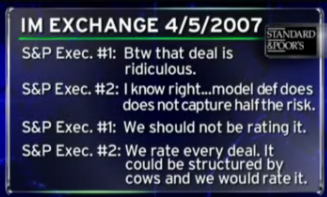
  • Firstly, a great article on Regulatory Arbitrage (which is something all the big banks pulled off during the recent bubble). It was written back in May 09, but it's a great primer for those who want to understand what exactly all those banks were doing with CDO's and why they were created: so that banks did not have to hold much capital. Here's a quick quote to give you a taste: "How does regulatory capital arbitrage work? ... the most straightforward to describe and to implement is securitization. Recall our bank earlier that had $100 in mortgages, for which it had to hold $4 in capital. Let’s say it creates a simple collateralized debt obligation out of these mortgages. It sells them to a special-purpose vehicle (SPV) that issues bonds to investors; these bonds are backed by the cash flows from the monthly mortgage payments. The bonds are divided into a set of tranches ordered by seniority (priority), so the incoming cash flows first pay off the most senior tranche, then the next most senior tranche, and so on. If these are high-quality mortgages, all the credit risk (at least according to the rating agencies) can be concentrated in the bottom few tranches (because it’s unlikely that more than a few percent of borrowers will default), so you end up with a few risky bonds and a lot of “very safe” ones. The magic is that by getting sufficiently high credit ratings for the senior tranches, the bank can lower the risk weights on those assets, thereby lowering the amount of capital it has to hold for those tranches. The risky tranches will require more capital, but it is possible to do the math so that the lower capital requirements on the senior tranches more than outweigh the higher requirements on the junior tranches. So you end up with lower total capital requirements – in some cases, 50% lower – simply through securitization." Thankfully, those ratings agencies are starting to come under fire, an interesting story in and of itself. Look at this ridiculous exchange between two S&P Execs (S&P is one of the big ratings agencies). That old defense of free speech is looking a little less plausible...
  • Janet Yellen, President of the San Francisco Fed, presents her outlook on the economy: "I am hugely relieved that our financial system appears to have survived this near-death experience. And, as painful as this recession has been, I believe that we succeeded in avoiding the second Great Depression that seemed to be a real possibility. Much of the recent economic data suggest that the economy has bottomed out and that the worst risks are behind us. The economy seems to be brushing itself off and beginning its climb out of the deep hole it’s been in. That’s the good news. But I regret to say that I expect the recovery to be tepid. What’s more, the gradual expansion gathering steam will remain vulnerable to shocks. The financial system has improved but is not yet back to normal. It still holds hazards that could derail a fragile recovery. Even if the economy grows as I expect, things won’t feel very good for some time to come. In particular, the unemployment rate will remain elevated for a few more years, meaning hardship for millions of workers. Moreover, the slack in the economy, demonstrated by high unemployment and low utilization of industrial capacity, threatens to push inflation lower at a time when it is already below the level that, in the view of most members of the Federal Open Market Committee (FOMC) best promotes the Fed’s dual mandate for full employment and price stability. As a result, monetary policy makers will continue to face a difficult task in the years ahead."
  • Calculated Risk presenting a couple bullish views on the economy. The author of the post disagrees with those views. (edit: My wording in the previous sentence is ambiguous. "The author" refers to Calculated Risk: the link goes to a CR post that presents two articles with bullish views, and then refutes them. I did not mean to imply I had a personal opinion either way. Sorry for any confusion.) Good points on both sides. Personally, I'm just wondering if the stock market is going to keep going up...
  • Remember the earlier point (4th bullet in my previous post) about how GDP might be overused in measuring the state of a nation? The Economist follows up!
  • More from The Economist, on an interesting new investment playground: patents.
  • Stephen Roach updates his views on the BRIC's. "'It's a myth that the baton of economic leadership is being seamlessly passed to the BRICs, in particular China. My premise is there is still a lot of work to be done,' says Roach." For those who don't know: Stephen Roach is a highly respected analyst and economist for Morgan Stanley, who is now their top executive in Asia. The BRIC's ... well, that's a must read, perhaps the most influential and widely accepted modern paper predicting the changing world landscape. Goldman Sachs' Global Economic Paper No. 99: Dreaming With BRIC's.
  • Peter Schiff revisits the demise of Lehman.
  • Will Flash Trading be banned? Wow, this would be remarkable. I'd prefer to see more efforts at fundamental regulatory reform, but realistically, this is more than I was expecting.
  • Dubuque, Iowa: America's first truly "Smart City"?

Friday, August 14, 2009

Should commercial banking be treated as a public utility?

Credit for this goes to my dad, who first brought this idea up to me. For the record, I don't think it will ever happen, but the idea is very much worth thinking about. I've captured the conclusion of an interesting article written by Numerian at The Agonist in this blog, but it's worth reading in its entirety:

"In fact, it sounds more and more like commercial banking, in a world where risks are priced and capitalized properly, is a world of modest profit and modest returns for shareholders. Doesn’t that sound like a utility to you? ..."

"... The Treasury and the Fed are propping up so many different markets that it is estimated some 30% of all finance comes from Washington now. Chase is one of the selected vehicles for channeling all this money, and it is allowed to take a generous transaction fee on every dollar. This is no longer banking, but rentier finance for a few institutions granted monopoly rights – again, the classic definition of a public utility."


What is called for is a highly regulated industry considered critical to common good that is in return guaranteed monopoly: essentially the concept of a public utility. It is worth, then, providing a related piece that is opposed to the idea that regulation is lacking. This piece is of the opinion that regulation was in place to deal with the instruments that led to the crisis; instead, what was lacking was enforcement of these regulations, which resulted in fraud.