Showing posts with label deflation. Show all posts

Friday, December 4, 2009

Double Dip threat is back?

A long while back, I wrote that I believed we would face a double-dip recession, though I certainly got the time-frame wrong.
Krugman just put up a post on the same issue, and it made me think about why we might still be facing this "W" shape recovery. It relates strongly to Brenner's paper below: we're running out of ways to stimulate business activity. There does not seem to be a bubble left to inflate. When government stimulus runs out (and I don't think we'll see another stimulus package - doesn't seem politically feasible right now) next year, who will spend? From Krugman:

Two stories this morning highlight the risks. The WSJ has a report on highway construction titled Job Cuts Loom as Stimulus Fades:
Highway-construction companies around the country, having completed the mostly small projects paid for by the federal economic-stimulus package, are starting to see their business run aground, an ominous sign for the nation’s weak employment picture.
Meanwhile, the ISM for manufacturing suggests that industrial growth is already slowing down.
I’d be more sanguine about all of this if there were any indications that private, final demand is taking off — consumers, business investment, whatever. But I haven’t seen anything suggesting that sort of thing.


Also, deflation is still looming. Japan is already there. America faces the prospect as well, though if the Treasury keeps pumping out dollars, we also face a risk of inflation down the road. Take a look at this, which has more on double-dip risk (emphasis mine):

The Fed has to do one of two things: They either have to pull $1.5 trillion out of the system by June, which would collapse the economy, or face hyperinflation. This is why the Fed has instructed banks to inform them when and how much of the TARP funds they can return. At best they can expect $300 to $400 billion plus the $200 billion the Fed already has in hand.
We believe the Fed will opt for letting the system run into hyperinflation. All signs tell us they cannot risk allowing the undertow of deflation to take over the economy. The system cannot stand such a withdrawal of funds. They also must depend on assistance from Congress in supplying a second stimulus plan. That would probably be $400 to $800 billion. A lack of such funding would send the economy and the stock market into a tailspin. Even with such funding the economy cannot expect any growth to speak of and at best a sideways movement for perhaps a year.

Their belief goes directly counter to my belief that we will not see a second stimulus plan. If we do not, as I believe, we face the deflationary threat and a true double-dip. If, however, another stimulus plan is passed (which seems more and more necessary, though I still think is too politically unacceptable in the short-term), we may be okay for a while yet.

I know this is a highly doom-and-gloom scenario. Hopefully, I'm wrong, and the world economy recovers more smoothly than I expect.

Also, I wanted to post a short follow-up to the Brenner post below. One thing his analysis does is completely destroy the China-decoupling theory. Note that it was a far more popular theory before the recession than it is now, but it does still get some mention. I think the Brenner write-up finishes it off in my mind, but here's some more on it anyway: The China Decoupling Myth.

Tuesday, October 6, 2009

Quick Links

Sorry for the lack of posts recently - been quite busy. Here are a few articles I think are worth reading:
  • The Baseline Scenario writes about monetary policy, taking a look at hawks vs. doves in the Fed. I never quite thought of hawks or doves in monetary policy, but it's a neat take.

    Hawks also like to talk a lot about “credibility,” which means a reputation for being willing to fight inflation. People use the word credibility in this context because the conventional wisdom used to be that national governments would not be willing to take tough steps (raising interest rates) against inflation because that would cost jobs, and hence votes in the next election. So central banks had to prove that they were willing to raise interest rates and put people out of work, even though that might be politically unpopular. Now that our Fed governors and bank presidents are accountable to just about no one, beating on their chests and proclaiming how willing they are to be tough in the face of the political winds rings a little hollow to me — especially in a “middle-class” country that considers inflation to be a greater evil than unemployment. Arguably, the situation has reversed; it has become so accepted that the primary job of a central bank is to fight inflation, despite the Fed’s dual mandate (to both fight inflation and promote stable economic growth), that fighting inflation has become the politically safe thing to do.
  • This is interesting, and for Americans, potentially alarming: China, Russia, Japan, France, and some Middle Eastern countries are planning to "end dollar dealings for oil." There's been quite a bit of noise over the past months about shifting away from the dollar as the main international currency, but (at least in articles I read, which I must note tend to be written by Americans) such talk has been largely dismissed. Apparently, we shouldn't dismiss so easily. The dollar is already weak in value, and such a move only further hurts its reputation. If this is actually going to happen, it will increase tension between China and America. It is also interesting that Japan, who has been a pretty close trade partner and ally since WWII, is part of this non-dollar alliance.
  • A profile of Larry Summers and his team.
  • Mish arguing that deflation is no longer a looming threat, it is here. Furthermore, he argues that it's a good thing! Take a look:

    Deflation is not a threat because deflation is here by any practical measurement. Deflation is also here by impractical measurements such as falling prices. See Humpty Dumpty On Inflation and Daniel Amerman vs. Mish: Reflections on the Great Inflation/Deflation Debate for a further discussion of a practical definition of deflation, a contraction of money supply and credit marked to market, not falling prices.

    Moreover, deflation is not a threat in a second sense. Deflation is needed to purge the excesses of the last credit cycle. Attempts to defeat deflation by force will only prolong the agony while accumulating government debt, just as happened in Japan's two lost decades.

    Finally, deflation is not a threat in a third sense. Falling prices are a natural state of affairs because of rising productivity over time.


Monday, September 28, 2009

Weekend Reading

I meant to publish this last evening (see title), but I completely forgot to actually hit the publish button. Oh well... here's some interesting stuff from the weekend:

  • My dad sent me this bit from Richard Russell of Dow Theory Letters fame. He writes about the world deflation story, based primarily on the fact that U.S. consumption has decreased while emerging market consumption is not increasing. The most interesting paragraph, to me, is quoted below (can anyone confirm if this is true? It's a fascinating little piece of information):
    Do you know the “why” of the Chinese wok? Fuel is scarce in China, and if food is diced and sliced and placed in a wok with a bit of oil, it will cook in a minute or so over a small fire. As soon as the food is cooked, the fire is put out and the remains of the fuel are saved for the next meal. Talk about fast food, wok-cooked food is the original fast food. Wok food is cooked as quickly and as inexpensively as possible.
    These are the billions of people we are dealing with. They live to work hard, and save — and to sell to the West, specifically to US consumers. And we wonder why there is world deflation.
  •  Harvard Magazine with a neat bit of historical analysis that I've shown before through many other articles. When we deregulate, we lose:
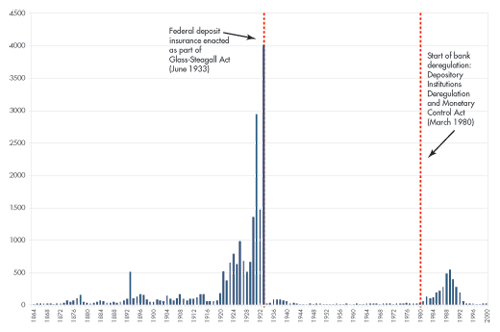
    Of course, financial panics and crises are nothing new. For most of the nation’s history, they represented a regular and often debilitating feature of American life. Until the Great Depression, major crises struck about every 15 to 20 years—in 1792, 1797, 1819, 1837, 1857, 1873, 1893, 1907, and 1929-33.
    But then the crises stopped. In fact, the United States did not suffer another major banking crisis for just about 50 years—by far the longest such stretch in the nation’s history.  
    Calm Amidst the Storm: Bank Failures (Suspensions), 1864-2000


  •  I like the title of this article: "It's Hard Being a Bear". That's part 5! I need to find and read parts 1-4. 5 shows, with a whole bunch of fancy charts and analysis, that the stimulus plan is failing to increase the broader money supply, which goes counter to classical economic theory. Summary: when the stimulus program runs out, we're going back to recession. This is assuming that the stimulus can't go on forever, though an IMF article recently mentioned an interesting tidbit. The IMF projects that the future cost of 'entitlements' (health care, social security, etc.) is 10x the future cost of stimulus. I'm not sure how accurate that projection is, but hey, it's the IMF. I'll trust them for now. The takeaway is that by reducing entitlements, the government may be able to continue stimulus for longer than one might expect. We're now getting dangerously near politics, so I'll leave it at that for you to chew on.
  • Krugman on Skidelsky on Keynes. Here's a really interesting quote from that review:
    Most strikingly, Skidelsky declares that the traditional division between microeconomics and macroeconomics, which is based on whether one focuses on individual markets or on the overall economy, is all wrong; macroeconomics should be defined as the field that studies those areas of economic life in which irreducible uncertainty, uncertainty that cannot be tamed with statistics, dominates. He goes so far as to call for a complete division of postgraduate studies: departments of macroeconomics should not even teach microeconomics, or vice versa, because macroeconomists must be protected "from the encroachment of the methods and habits of mind of microeconomics".
  • Was the G-20 summit dangerous? This article claims that there are fundamental differences between American and European banking that should really make for different solutions on either side of the Atlantic. Obama's drive to have a common solution might actually make for more harm than good:
    Obviously, raising capital standards in the US is going to be a long and drawn out fight.  The G20 could help, if it set high international expectations, but the opposite is more likely.  As Nocera suggests this morning, the inclination of the Europeans – largely because of their funky “hybrid” capital, but also because they have some very weak banks – will be to drag their feet.
    Why should we care?  This administration seems to think that we need to bring others with us, if we are to strengthen capital requirements.  Our progress will be slowed by this thinking, the glacial nature of international economic diplomacy, and the self-interest of the Europeans.

Wednesday, September 2, 2009

Wednesday Reading

Never mind that bit about this being a slow news week. Plenty of good reading.

Tuesday, September 1, 2009

Tuesday Reading

Been a slow news week so far, and I've been too busy for a lengthy post. However, here are a few good reads:
  • Amazing Vanity Fair profile on Henry Paulson, built up over 15 months of regular interviews. I haven't finished the whole thing, but it looks quite intriguing. Some telling quotes about our lawmakers: "“There’s a great lack of financial literacy and understanding in this nation, even among college-educated people.” ... As his tenure wore on, Paulson confessed, “I amuse myself a lot by sitting there (Capitol Hill) sometimes and thinking what would happen if I said, ‘Do you realize what an idiotic question that is?’" This goes back to something I've mentioned before: there's a serious, serious lack of financial education in this country, despite the fact that financial literacy is required in so many aspects of our lives.
  • Speaking of Paulson, his brainchild, TARP, is showing some early returns.
  • Deflation in Spain.
  • FDIC is in trouble.
  • One more: Hussman showed an interesting chart in his weekly market commentary (sent to me by a reader. Reader, you know who you are - I'll keep you anonymous unless you wish to be known =) ). All I want to focus on is that the recent crash, and the steps the government has taken, are unprecedented in the post-war era:

Thursday, August 27, 2009

More on Inflation vs. Deflation

Roubini has a great article in Forbes talking about how government policies today can be causes for deflation and inflation. In fact, he discusses what I mentioned in my post on the topic: a fear of short-term deflation and long-term inflation. I'm so proud of myself! .... assuming Roubini's right, that is.

I'm highlighting some relevant passages here, but I would strongly encourage you to read the entire writeup. Any emphasis is mine.


"The fiscal implications of the current policy package are particularly serious. For the time being, fiscal policy has been put at the service of survival, but the current price of survival is that net public debt is going to double as a share of GDP between 2008 and 2014. Even using the very optimistic forecasts of the Congressional Budget Office, which anticipate growth of around 4% over the next few years, the net debt burden will rise from 40% of GDP to 80%--that's an increase in the debt stock of about $9 trillion. The interest charge alone on that increased debt will be in the region of $300 billion to $400 billion a year, which in turn may mean more borrowing to pay the interest if primary deficits are not reduced. When governments reach the point where they are borrowing to pay the interest on their borrowing they are coming dangerously close to running a sovereign Ponzi scheme."
"Ponzi schemes have a way of ending unhappily. To get out of the Ponzi trap, governments will have to raise taxes, or cut spending, or monetize the debt--or most likely do some combination of all three."
"Over time, monetization is inflationary, but the inflationary effect is insidious because it is not immediately visible. In the short run deflation will outplay inflation. In most developed countries today there is so much slack in economies, with weak demand and high unemployment, that prices cannot rise. The velocity of money is also weak, as financial institutions are receiving liquidity from central banks and hoarding it to rebuild their balance sheets, instead of lending it out. But as the economy recovers, these effects will abate, and the growth of the monetary base caused by monetization will eventually drive expected and actual inflation. And once markets start to anticipate that scenario, it may already be too late to avert an inflationary surge."

It is important to note that Roubini does say the massive government support was necessary to avert disaster: "This massive escalation of central government spending and borrowing was necessary." He is primarily discussing how the result of that intervention makes for a "damned if you do, damned if you don't" scenario.

Tuesday, August 25, 2009

Inflation? Deflation? Both?

Of course, not at the same time. However, this question has been on my mind recently.

First, a quick Econ 101 review (I had to look this stuff up, I swear) courtesy Wikipedia:
Inflation: "In economics, inflation is a rise in the general level of prices of goods and services in an economy over a period of time. ... A chief measure of price inflation is the inflation rate, the annualized percentage change in a general price index (normally the Consumer Price Index) over time."
Naturally then, Deflation: "In economics, deflation is a decrease in the general price level of goods and services. Deflation occurs when the annual inflation rate falls below zero percent, resulting in an increase in the real value of money — a negative inflation rate. This should not be confused with disinflation, a slow-down in the inflation rate (i.e. when the inflation decreases, but still remains positive). Inflation reduces the real value of money over time, conversely, deflation increases the real value of money." (here's another good explanation article on deflation from Inflationdata.com)

One further important point: headline vs. core inflation. Core inflation uses a CPI that excludes food and energy prices. This has, in recent times, been controversially viewed as a more accurate measure of inflation. The argument for it is that food and energy prices are too volatile to be considered as part of CPI. It's important to note that the Fed tends to use core inflation as it's guide, though they've recently had to review that policy. The controversy stems from the fact that, one, consumers *do* need to pay for food and energy, and two, there are more volatile aspects to CPI than food anyway, according to research from the Philly Fed.
Yikes, eh? Makes things pretty complicated. And to make things even more fun, headline inflation is negative while core is slightly positive.

It's important to note that what needs to be avoided is hyper-inflation and deflation (this also is arguable, but let's go with conventional thinking for now). As far as I know, it's generally accepted that moderate inflation is considered the most healthy scenario for an economy. I draw heavily from the SF Fed for the following analysis:
  • High inflation is dangerous and prevents economic growth: for example, price change in a product could no longer be easily define by supply and demand if inflation could just as easily be the cause. Also, high inflation tends to have higher fluctuation, which causes consumer and investment uncertainty.
  • Zero inflation is dangerous because this usually implies lending rates close to 0, which leaves the Fed very little room for stimulus if necessary.
  • Thus, you're left with moderate inflation as the safest path. Kinda roundabout, but hey - that's what I've gathered so far.
We also need to address why deflation is generally considered dangerous (again, from SF Fed):
  • In deflation, prices are falling throughout the economy - and that actually sounds kinda nice at first glance, from a consumer's perspective. However, keep in mind that deflation increases the burden on borrowers (read: consumers) in the case of a fixed-rate loan, and prolonged deflation can reduce the value of collateral, again making borrowing (credit) more difficult to come by. Lastly, again, the Fed would probably be stuck at 0% interest rates and would be unable to properly stimulate the economy.
Ok. All that's out of the way. I think we have a very rudimentary understanding of what we want, and what we don't. So, what might be coming?

It's good to get a review of what can actually cause inflation and deflation.

What can cause inflation:
  • Increasing supply of money
  • Decreasing supply of goods
  • Increasing demand for goods
  • Decreasing demand for money
Deflation is the opposite:
  • Decreasing supply of money
  • Increasing supply of goods
  • Decreasing demand for goods
  • Increasing demand for money

The inflation-is-coming faction bases their claims on the Fed's liberal pumping of money into the economy (first bullet for inflation). Though CPI has been falling, many attribute this to dramatic falls in food and energy prices, as well as dramatic falls in rental and property prices - and despite all this, notice Core CPI never went negative!. When these factors begin to recover, inflation will jump with it.
The deflation-is-coming camp, however, notes that there has indeed been negative Headline CPI, and that there is no guarantee prices will recover. Even despite the recovery in energy prices, which will force headline CPI back up, rent and wages are still falling and will be much more serious components of the measure.

I'm leaning towards the deflation camp in the short term. Layoffs are on-going, and though they're slowing, they're still happening! This means lots of people with less purchasing power, which will force rents down and the price of goods down, based on decreasing demand. The Fed already has interest rates at 0 - if things go bad, they won't be able to easily stimulate things again, which is further danger of deflation. And yes, I believe we're not out of the woods and that we are likely in line for a U- or W-shape recovery.
In the long-term, however, the picture is more murky. The Fed has pumped a LOT of money into the system (take a look at their balance sheet! I link to that in the Econbrowser article below) and if/when recovery occurs, that increased supply could make for serious inflation.

Here are some good reads on the topic:
Lastly, I'm no expert on ANY of this stuff. I hardly know monetary policy. Please, if anyone has more insight, feel free to comment and criticize. I would love to understand this better.

A few follow-up points I think are important:
1. It's unclear that deflation is necessarily bad. Many tend to use the Great Depression or Japanese experience as examples of why deflation is bad; in fact, it can be argued deflation occurred during the Industrial Revolution (supply of goods increased dramatically) and this was a good thing. So, deflation could be good or bad depending on the situation. This is taken from the Inflationdata.com article linked earlier in this post.
2. There are many debatable measures of inflation. I tried to stay with mainstream analysis for this post.
3. This is all based on the conventional definition of money supply where money is currency. I didn't discuss money supply enough in this post, but it is very important in understanding inflation.

**UPDATE** The market and the Fed seem to disagree on where interest rates are headed, which implies differing views on coming inflation (the market seems to think it's more likely than economists do).

Sunday, August 23, 2009

Sunday Links