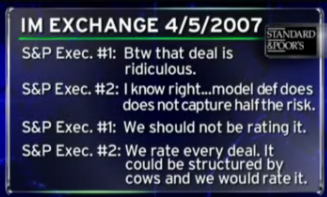
- Firstly, a great article on Regulatory Arbitrage (which is something all the big banks pulled off during the recent bubble). It was written back in May 09, but it's a great primer for those who want to understand what exactly all those banks were doing with CDO's and why they were created: so that banks did not have to hold much capital. Here's a quick quote to give you a taste: "How does regulatory capital arbitrage work? ... the most straightforward to describe and to implement is securitization. Recall our bank earlier that had $100 in mortgages, for which it had to hold $4 in capital. Let’s say it creates a simple collateralized debt obligation out of these mortgages. It sells them to a special-purpose vehicle (SPV) that issues bonds to investors; these bonds are backed by the cash flows from the monthly mortgage payments. The bonds are divided into a set of tranches ordered by seniority (priority), so the incoming cash flows first pay off the most senior tranche, then the next most senior tranche, and so on. If these are high-quality mortgages, all the credit risk (at least according to the rating agencies) can be concentrated in the bottom few tranches (because it’s unlikely that more than a few percent of borrowers will default), so you end up with a few risky bonds and a lot of “very safe” ones. The magic is that by getting sufficiently high credit ratings for the senior tranches, the bank can lower the risk weights on those assets, thereby lowering the amount of capital it has to hold for those tranches. The risky tranches will require more capital, but it is possible to do the math so that the lower capital requirements on the senior tranches more than outweigh the higher requirements on the junior tranches. So you end up with lower total capital requirements – in some cases, 50% lower – simply through securitization." Thankfully, those ratings agencies are starting to come under fire, an interesting story in and of itself. Look at this ridiculous exchange between two S&P Execs (S&P is one of the big ratings agencies). That old defense of free speech is looking a little less plausible...
- Janet Yellen, President of the San Francisco Fed, presents her outlook on the economy: "I am hugely relieved that our financial system appears to have survived this near-death experience. And, as painful as this recession has been, I believe that we succeeded in avoiding the second Great Depression that seemed to be a real possibility. Much of the recent economic data suggest that the economy has bottomed out and that the worst risks are behind us. The economy seems to be brushing itself off and beginning its climb out of the deep hole it’s been in. That’s the good news. But I regret to say that I expect the recovery to be tepid. What’s more, the gradual expansion gathering steam will remain vulnerable to shocks. The financial system has improved but is not yet back to normal. It still holds hazards that could derail a fragile recovery. Even if the economy grows as I expect, things won’t feel very good for some time to come. In particular, the unemployment rate will remain elevated for a few more years, meaning hardship for millions of workers. Moreover, the slack in the economy, demonstrated by high unemployment and low utilization of industrial capacity, threatens to push inflation lower at a time when it is already below the level that, in the view of most members of the Federal Open Market Committee (FOMC) best promotes the Fed’s dual mandate for full employment and price stability. As a result, monetary policy makers will continue to face a difficult task in the years ahead."
- Calculated Risk presenting a couple bullish views on the economy. The author of the post disagrees with those views. (edit: My wording in the previous sentence is ambiguous. "The author" refers to Calculated Risk: the link goes to a CR post that presents two articles with bullish views, and then refutes them. I did not mean to imply I had a personal opinion either way. Sorry for any confusion.) Good points on both sides. Personally, I'm just wondering if the stock market is going to keep going up...
- Remember the earlier point (4th bullet in my previous post) about how GDP might be overused in measuring the state of a nation? The Economist follows up!
- More from The Economist, on an interesting new investment playground: patents.
- Stephen Roach updates his views on the BRIC's. "'It's a myth that the baton of economic leadership is being seamlessly passed to the BRICs, in particular China. My premise is there is still a lot of work to be done,' says Roach." For those who don't know: Stephen Roach is a highly respected analyst and economist for Morgan Stanley, who is now their top executive in Asia. The BRIC's ... well, that's a must read, perhaps the most influential and widely accepted modern paper predicting the changing world landscape. Goldman Sachs' Global Economic Paper No. 99: Dreaming With BRIC's.
- Peter Schiff revisits the demise of Lehman.
- Will Flash Trading be banned? Wow, this would be remarkable. I'd prefer to see more efforts at fundamental regulatory reform, but realistically, this is more than I was expecting.
- Dubuque, Iowa: America's first truly "Smart City"?


 Posts
Posts


People Incorporated: From Predator To Prey
2 days ago