Monday, September 28, 2009

Weekend Reading

I meant to publish this last evening (see title), but I completely forgot to actually hit the publish button. Oh well... here's some interesting stuff from the weekend:

  • My dad sent me this bit from Richard Russell of Dow Theory Letters fame. He writes about the world deflation story, based primarily on the fact that U.S. consumption has decreased while emerging market consumption is not increasing. The most interesting paragraph, to me, is quoted below (can anyone confirm if this is true? It's a fascinating little piece of information):
    Do you know the “why” of the Chinese wok? Fuel is scarce in China, and if food is diced and sliced and placed in a wok with a bit of oil, it will cook in a minute or so over a small fire. As soon as the food is cooked, the fire is put out and the remains of the fuel are saved for the next meal. Talk about fast food, wok-cooked food is the original fast food. Wok food is cooked as quickly and as inexpensively as possible.
    These are the billions of people we are dealing with. They live to work hard, and save — and to sell to the West, specifically to US consumers. And we wonder why there is world deflation.
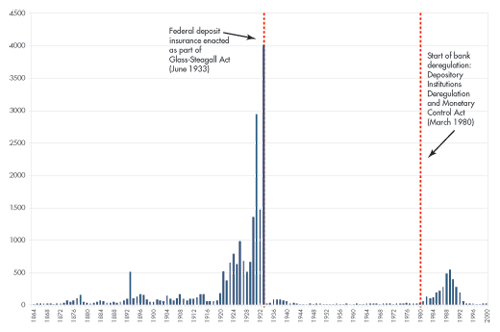
  •  Harvard Magazine with a neat bit of historical analysis that I've shown before through many other articles. When we deregulate, we lose:
    Of course, financial panics and crises are nothing new. For most of the nation’s history, they represented a regular and often debilitating feature of American life. Until the Great Depression, major crises struck about every 15 to 20 years—in 1792, 1797, 1819, 1837, 1857, 1873, 1893, 1907, and 1929-33.
    But then the crises stopped. In fact, the United States did not suffer another major banking crisis for just about 50 years—by far the longest such stretch in the nation’s history.  
    Calm Amidst the Storm: Bank Failures (Suspensions), 1864-2000


  •  I like the title of this article: "It's Hard Being a Bear". That's part 5! I need to find and read parts 1-4. 5 shows, with a whole bunch of fancy charts and analysis, that the stimulus plan is failing to increase the broader money supply, which goes counter to classical economic theory. Summary: when the stimulus program runs out, we're going back to recession. This is assuming that the stimulus can't go on forever, though an IMF article recently mentioned an interesting tidbit. The IMF projects that the future cost of 'entitlements' (health care, social security, etc.) is 10x the future cost of stimulus. I'm not sure how accurate that projection is, but hey, it's the IMF. I'll trust them for now. The takeaway is that by reducing entitlements, the government may be able to continue stimulus for longer than one might expect. We're now getting dangerously near politics, so I'll leave it at that for you to chew on.
  • Krugman on Skidelsky on Keynes. Here's a really interesting quote from that review:
    Most strikingly, Skidelsky declares that the traditional division between microeconomics and macroeconomics, which is based on whether one focuses on individual markets or on the overall economy, is all wrong; macroeconomics should be defined as the field that studies those areas of economic life in which irreducible uncertainty, uncertainty that cannot be tamed with statistics, dominates. He goes so far as to call for a complete division of postgraduate studies: departments of macroeconomics should not even teach microeconomics, or vice versa, because macroeconomists must be protected "from the encroachment of the methods and habits of mind of microeconomics".
  • Was the G-20 summit dangerous? This article claims that there are fundamental differences between American and European banking that should really make for different solutions on either side of the Atlantic. Obama's drive to have a common solution might actually make for more harm than good:
    Obviously, raising capital standards in the US is going to be a long and drawn out fight.  The G20 could help, if it set high international expectations, but the opposite is more likely.  As Nocera suggests this morning, the inclination of the Europeans – largely because of their funky “hybrid” capital, but also because they have some very weak banks – will be to drag their feet.
    Why should we care?  This administration seems to think that we need to bring others with us, if we are to strengthen capital requirements.  Our progress will be slowed by this thinking, the glacial nature of international economic diplomacy, and the self-interest of the Europeans.

Thursday, September 24, 2009

Keynes Is Popular Again

I pointed to this trend in a previous post: the work of John Maynard Keynes has been largely disregarded for the past 50 years as out-dated. Recently, however, people are starting to take his work seriously again. Here is another excellent column on why Keynes seems valuable again. The key point (behavioral economics strikes again!) is quoted here, and as usual, emphasis in bold is mine:

The General Theory is a hard slog, though not because it is mathematical. There is some math, but it is simple and, with the exception of the formula for the "multiplier" (of which more shortly), it is incidental to Keynes's arguments. A work of elegant prose, the book sparkles with aphorisms ("It is better that a man should tyrannize over his bank balance than over his fellow-citizens") and rhetorical flights (most famously that "madmen in authority, who hear voices in the air, are distilling their frenzy from some academic scribbler of a few years back"). But it also bristles with unfamiliar terms, such as "unit-good" (an hour's employment of ordinary labor), and references to unfamiliar economic institutions, such as a "sinking fund" (a fund in which money is accumulated to pay off a debt). ...

It is an especially difficult read for present-day academic economists, because it is based on a conception of economics remote from theirs. This is what made the book seem "outdated" to Mankiw--and has made it, indeed, a largely unread classic. (Another very distinguished macroeconomist, Robert Lucas, writing a few years after Mankiw, dismissed The General Theory as "an ideological event.") The dominant conception of economics today, and one that has guided my own academic work in the economics of law, is that economics is the study of rational choice. People are assumed to make rational decisions across the entire range of human choice, including but not limited to market transactions, by employing a form (usually truncated and informal) of cost-benefit analysis. The older view was that economics is the study of the economy, employing whatever assumptions seem realistic and whatever analytical methods come to hand. Keynes wanted to be realistic about decision-making rather than explore how far an economist could get by assuming that people really do base decisions on some approximation to cost-benefit analysis.

The General Theory is full of interesting psychological observations--the word "psychological" is ubiquitous--as when Keynes notes that "during a boom the popular estimation of [risk] is apt to become unusually and imprudently low," while during a bust the "animal spirits" of entrepreneurs droop. He uses such insights without trying to fit them into a model of rational decision-making.

Wednesday, September 23, 2009

Moody's Might Be In Trouble

I've made mention of ratings agencies being one of the core reasons for the recent housing bubble. Although it's of course too late to help with immediate problems, it is important that we understand what they were doing, why it was bad, and how it can be controlled in the future.

Let me provide some background for the larger context of this post. A commenter and I recently had the following exchange in the comments following a post here:
Wanna said...

Philosophically speaking boom and bust are a way of life and that is the way it should be. Fed should not try to anticipate a boom and nip it in its bud. How would the Fed know in advance that a bubble is going to happen. These things are evident only in hindsight (which of course is 20/20 for TV and market pundits). Fed's job as Greenspan and Bernanke have said before should be that of a mopper rather than a boom-breaker.

Adit said...

Why is it that "boom and bust" is the way it should be? Would it not be better to target steady, sustainable growth rather than extreme run-ups followed by sharp letdowns over and over?

Wanna said...

By suggesting that "Would it not be better to target steady, sustainable growth" you are probably saying that Fed knows two things: 1. the number for steady, sustainable growth. Is it 3% per year, is it 5% per year, is it 8% per year? Which number should Fed use? Depending on which number you pick then the next question is 2. How do you know that is a correct number? China is growing at more than 8% per year. Should Chinese Fed have tried to rein in this party long time back because 8% is such a big number?

This is similar to Monday morning Quarterbacking. Most people's hindsight is perfect.

Mopping up post party is much better than reigning in the party prematurely.


I did not answer in the comment section, but I did put the following hasty thoughts together in an email sent to Wanna later:

I think you make a good point that setting targets is difficult, but at the same time, directly reigning in bubble-like growth isn't necessarily the idea. Instead, I go back to regulatory reform. One example: If there was proper oversight on ratings agencies so that they couldn't rate a big collection of junk as AAA quality when it should have been B or worse, much of the rampant real estate speculation and associated market tools could never have been exploited to the degree they were. This would have indirectly limited the extent of the bubble. Perhaps then, the comments shouldn't be aimed at the Fed, but at the government in general. Basically, I don't see how a bubble like the tech bubble could have been prevented: that was pure speculation that I can't think of reigning in, because it was due to an extremely bullish, forward-looking investment sentiment that was just the market being silly. This more recent bubble might have been less bubble-like if regulations were in place to limit financial "innovation" that really just took advantage of bad gov't. Keep in mind that it also allowed banks to reduce capital requirements which is a more dangerous state of affairs than what existed during the tech bubble. So, you're right: the Fed's job is to clean up after the mess and regulation reform is outside Fed purview. But smart regulation could perhaps mitigate *some* bubbles, which is better than letting them all through. I wonder if the S&L crisis was exploitation of similar gov't inadequacy. Let me predict that your counter will be that there will always be loopholes we will only see in retrospect, and the gov't will thus perpetually be inherently inadequate. I hope this is not true, and I wonder if it comes back again to the lack of financial literacy in the public. If this literacy rate was higher, perhaps financial "innovation" would be more transparent and idiocy would be caught more quickly.


p.s. Wanna's response was indeed that gov't will always be inadequate. I can't dispute that. Not all bubbles can be prevented, not all idiocy can be controlled. However, the government has a responsibility to control what it can. One thing it can control is transparency of ratings given by ratings agencies: it can be argued that these ratings fueled much of the equity market bubble by enabling all the exotic "financial innovations" Wall St. put together during that time. Also, buried in the guest post made yesterday, is a paper from the Dallas Fed arguing against Wanna: it is imperative that we not simply sit back and clean up after the party.

As such, there are two solutions that I see: one, as mentioned in other posts in this blog, is financial literacy. This is a topic that probably goes beyond the scope of this blog, as that seems more like educational policy than anything else. The other is regulatory reform, which I've been hammering at for a while. Congress investigating Moody's is a step in the right direction on that front, though Congress should look at regulation of all various financial institutions and do their best to ensure transparency on all issues. Going after ratings agencies should be one step in a larger, broader process.


Throughout the financial crisis, major credit-ratings firms were criticized for their overly rosy ratings of complex debt securities, which deteriorated soon after and led to billions of dollars of investor losses.

Despite months of regulatory scrutiny and some internal changes at the firms, a recently departed Moody's Corp. analyst says inflated ratings are still being issued. He has taken his concerns to congressional investigators.

The analyst, Eric Kolchinsky, said Moody's Investors Service gave a high rating to a complicated debt security in January 2009 knowing that it was planning to downgrade assets that backed the securities. Within months, the securities were put on review for a downgrade.

"Moody's issued an opinion which was known to be wrong," Mr. Kolchinsky wrote in a July letter to the rating firm's chief compliance officer, a copy of which was reviewed by The Wall Street Journal. In the letter, Mr. Kolchinsky cited other instances in which he believes inflated ratings were given to securities.

Nice Update on SEC (Rakoff) vs. BoA

Last June, when Bank of America CEO Ken Lewis was asked by a U.S. House committee why the bank hadn't disclosed seemingly important information about its upcoming Merrill Lynch acquisition in a proxy statement last November, he had a ready response:

"I'm not a securities lawyer," he said. "I don't decide on disclosures."

...

But now, thanks to U.S. District Judge Jed Rakoff of Manhattan, the stonewall is crumbling.

...

SEC: We can't prove the individual executives did anything wrong because they tell us they simply delegated to their lawyers the task of handling the disclosure obligations.

Rakoff: Then go after the lawyers.

SEC: We don't know what the lawyers said, since the executives invoked their attorney-client privileges.

Rakoff: If the officers are saying they relied on counsel, they're automatically waiving the privilege. Plus, there's a crime-fraud exception to the privilege, so you could have asked me to order them to answer.

SEC: Not really. We haven't charged anybody with fraud. We just charged a lesser infraction -- filing a false proxy statement -- which does not require proof of a fraudulent state-of-mind, so the officers never had to formally invoke a reliance-on-counsel defense. Accordingly, neither the bank nor Merrill ever waived their attorney-client privileges either.

Rakoff: Why didn't you charge anyone with fraud?

SEC: We couldn't prove fraudulent intent.

Rakoff: Why not?

SEC: They said they relied on advice of counsel.

See why Rakoff got steamed?


This article is a great read on the status of the SEC vs. Bank of America case, mostly for that last segment on 'why Rakoff got steamed'. Hopefully, something will come of this. Transparency at the big banks, and on Wall St. in general, is badly needed. This also plays into a post on corporate governance I still need to do.

Tuesday, September 22, 2009

Guest Post on Regulatory Reform and Beyond

I'm excited. Guest post! Always wanted to do this.
FYI - any of you readers, if you want to put some thoughts up here, email me. You all know how to contact me.

This post is from Pramod Khargonekar.


Martin Wolf is a highly respected and influential economist who writes a regular column for Financial Times (www.ft.com). A wonderful article, Call of the Wolf, describing on Martin Wolf can be found at http://www.tnr.com/article/economy/call-the-wolf?page=0,0.

In his article in FT on September 15, 2009 (http://www.ft.com/cms/s/0/b24477de-a226-11de-9caa-00144feabdc0.html), he wrote an excellent piece on what lessons we can take away from the fall of Lehman brothers a year ago.

“If the price of oil stabilises, I believe we can weather the financial crisis at limited cost in terms of real activity.” Thus did Olivier Blanchard, newly appointed head of the International Monetary Fund’s research department, describe the prospects ahead on September 2 2008. He was swiftly proved wrong

Few economists then realised how fragile the global financial system had become. The failure of Lehman Brothers just under two weeks later and the ensuing crisis at AIG, the insurance giant, turned complacency into terror. The financial system plunged into an abyss, dragging the economy behind it.

This is only partially true. People like Roubini, Schiff, and many others did warn of the troubles quite accurately. But the larger point that the collapse stunned most of the people is quite true.

What lessons are we to learn from this shock, a year later?

Above all, the true insurers of the financial system can be seen in our mirrors. According to the IMF’s Global Financial Stability Report of April 2009, total support for the financial system from the governments and central banks of the US, the eurozone and the UK has amounted to $8,955bn (£5,436bn, €6,132bn) – $1,950bn in liquidity support, $2,525n in asset purchases and $4,480bn in guarantees.

These numbers should be etched on a large stone on Wall and Broad Street. To put these numbers in perspective, US annual GDP is around $14,000bn. So, we have spent close to 60% of US annual GDP to support the companies in the financial sector.

These sums are misleadingly precise. The painful truth is that the incomes of taxpayers were put at the disposal of the financial sector’s creditors. When finance ministers and central bank governors of the Group of Seven leading developed countries met in Washington last October, they decided to “take decisive action and use all available tools to support systemically important financial institutions and prevent their failure”. Desperate times; desperate measures.

Since large financial institutions are most likely to fail during a crisis, this amounted to an open-ended government guarantee. What makes the decision quite unbearable is that it was, in my view, also correct. The risk of a cascading failure of the good, the bad and the ugly among financial institutions was apparent. Given what had happened after Lehman’s failure, only fools would have run this experiment. We were not that foolish.


This is the key argument --- the bailout was necessary. There is the other side of the argument which says we should let companies fail. It is impossible to know which would have been the better choice: bailout as was done or let them fail. At this point, it is an academic issue. Indeed, what has been done to deal with this crisis will be used to draw lessons when it comes to future crises which are bound to happen. In this sense, Ben Bernanke, Hank Paulson, Tim Geither, Larry Summers are writing the book which will be studied by future economists and policy makers.

Thus, the lesson learnt from Lehman’s failure was the precise opposite of what many had hoped on the day it was announced: it is that every systemically significant institution must be rescued in a crisis. That lesson is reinforced by Wednesday’s agreement that the rescue, buttressed by unprecedented monetary and fiscal stimulus, has worked: the panic is over and the world economy is on the mend.

We still have so many systemically important institutions. So, there has been no change in the “too big to fail” situation.

Indeed, one can argue that the Lehman failure was necessary. Without such an event, there was no chance of obtaining the resources needed to resolve the crisis, above all from the US Congress. This is what the Harvard historian Niall Ferguson argued in the FT on Tuesday. It is likely that he is right.

Everything, in short, has been for the best in the best of all possible worlds. In retrospect, it was right to let Lehman go, because it caused such a disaster. That then forced a public sector resolution of the crisis and taught that such a failure must never be allowed again. If these are indeed the sorts of lessons we draw, we are making huge mistakes.

We are now getting to the punch lines of the Wolf article:

First, we cannot let stand the doctrine that systemically significant institutions are too big or interconnected to be allowed to fail in a crisis. No normal profit-seeking business can operate without a credible threat of bankruptcy.

Thus, President Barack Obama is correct to call for the “most ambitious overhaul of the financial system since the Great Depression”. The communiqué of the Group of 20 finance ministers and central bank governors outlines the current agenda for reform. It is quite sensible, so far as it goes.

The question, however, remains whether enough will be done to eliminate the present incentives to game the system. It must be possible to wind up institutions without the damage we witnessed after Lehman’s collapse. This has come to be called a “living will”. A better term would be “assisted euthanasia”. Should that be impossible, these institutions must be under the sort of regulation that we normally apply to utilities.


I have previously talked about the “public utility” model for the financial sector. (ed. note: I summarized some of his thoughts on this idea in this post.) It is great to see that Wolf also advocates the same notion. The only other way is to have a well designed system that eliminates the very notion of too big to fail.

The second big potential mistake is to return to the old doctrine that it is better to clean up after a crisis than to take any pre-emptive action. Yet, the more effective the present clean-up seems, the more likely is it that central bankers will draw that lesson. They can argue that, if we have been able to survive such a huge crisis, no changes in the policy orthodoxy are needed.

This would be a huge error, as William White, formerly chief economist of the Bank for International Settlements, argues in a thought-provoking paper.* Mr White, one of the few economists in the official sector to warn of a looming crisis, argues that the “macroprudential” approach, now increasingly accepted, cannot rely on regulation alone. It is almost impossible for such regulation to offset the powerful incentives for credit creation produced by expansionary monetary policies. Thus, argues Mr White, “pre-emptive tightening” should replace “pre-emptive easing”. If we look back at the past two decades of ever more desperate efforts to clean up after crises, the wisdom of this “belt and braces” approach will seem evident.


I think it is an interesting intellectual problem. Can one design a system to detect bubbles? Can one create numerical measures of “bubbliness”? It sounds like an engineering or machine learning problem. It may be hard, possibly impossible, since the system may change over time making the measures designed on the basis of past data inadequate or useless. (ed. note: a commentor on this blog has argued against the idea of preemptive bubble killing in the comments in this post.)

The third big mistake is more immediate: it is to assume that we are already well on the way to a healthy recovery. The financial panic is indeed over, as it should be, given the scale of government guarantees. The economic dangers are not.

The recovery has been fuelled by the bail-out of the financial system and by extraordinary fiscal and monetary policies, particularly in the countries with the highest private-sector leverage. For good reason, the private sectors of such countries are likely to save more and pay down debt for years to come. This, in turn, now necessitates a big swing in the balance between supply and demand in export-dependent economies.

Mr Blanchard has set out the post-crisis macroeconomic agenda in a recent article.** As he puts it, we must manage delicate “rebalancing acts” – first, “rebalancing from public to private spending”; second, “rebalancing aggregate demand across countries”. Unless and until both are managed, the recovery is built on quicksand.


Only the future will tell whether the recovery is sustainable or built on quicksand. It is amazing how the stock market anticipated the current recovery. As it happens, real economy responds to perceptions of people (which in turn are influenced by the stock market and jobs and the real economic conditions. (Soros calls this reflexivity. It is also related to the idea of animal spirits, currently championed by Akerloff and Shiller.)

Letting Lehman go was not our biggest mistake. That was letting the economy and financial system become so vulnerable. Equally, the past year has restored neither the financial system nor the economy to health. We have avoided the worst. That is good. It is not enough.


There it is. A multi trillion dollar question is: will we really make any substantial changes in response to this major collapse which has led to near 10% unemployment rate!